Knowing How to Fingerprint Is One Skill. Knowing When NOT To Is Another.
Oct 07, 2026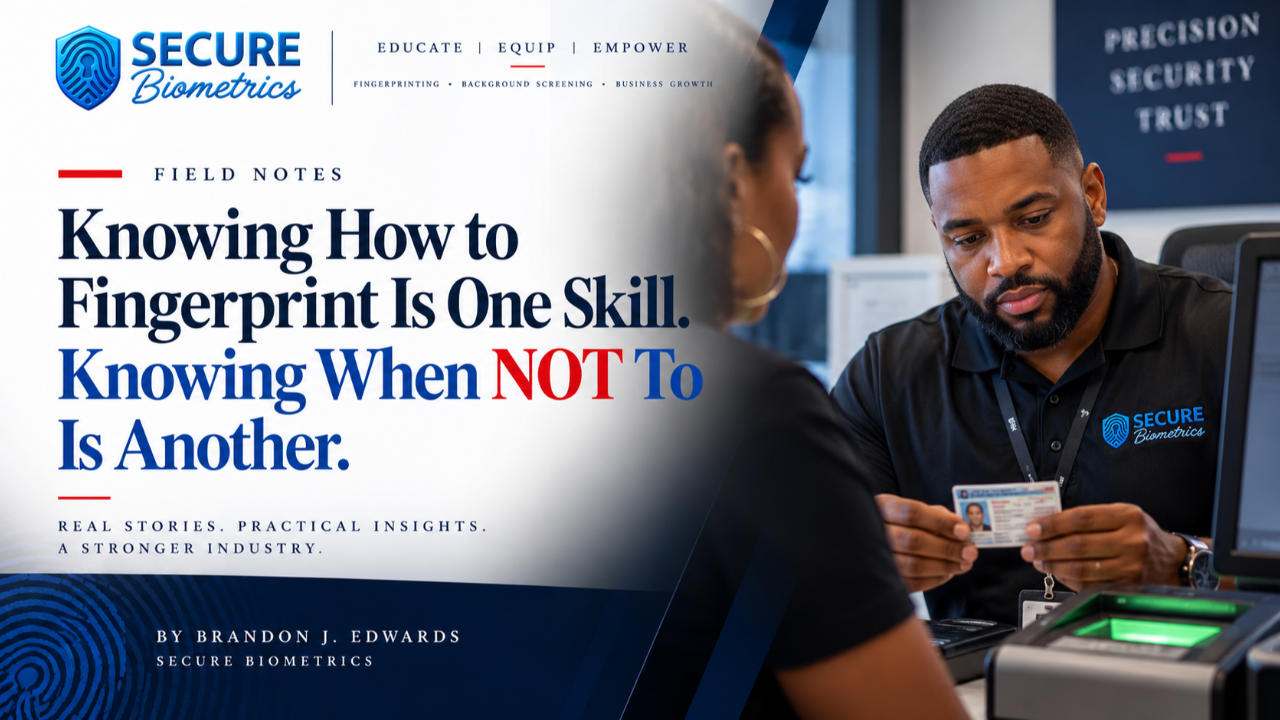
FIELD NOTES | October 7, 2026
By Brandon J. Edwards, Secure Biometrics
Last week, we had a customer come in for what should have been a routine fingerprinting appointment.
Check the identification. Confirm the information. Capture the fingerprints. Complete the transaction.
Except something didn’t add up.
Our COO was reviewing the customer’s identification and demographic information when she stopped the process and came to me.
“I’m not comfortable fingerprinting her.”
My response was simple:
Then don’t.
That may sound obvious, but when you’re running a business, saying no to money isn’t always easy.
Your Job Is Bigger Than Capturing Prints
One of the things I teach fingerprinting business owners is that knowing how to roll a good set of prints or operate Live Scan equipment is only part of the job.
You’re also responsible for the integrity of your process.
We work with identifying information, sensitive transactions, government agencies, employers, licensing bodies and, in many cases, decisions that can affect someone’s livelihood.
Sometimes your professional judgment has to override your desire to complete the sale.
In this case, something about the information presented raised enough concern that our COO wasn’t comfortable proceeding.
She didn’t accuse the customer of anything. She didn’t interrogate her. And she didn't try to play detective.
She simply recognized that she wasn't comfortable completing the transaction as presented.
That matters.
“No” Doesn't Have to Mean Bad Customer Service
Here’s the part of the story I really liked:
We still made the sale.
Instead of completing the fingerprinting service ourselves, we offered the customer a self-print kit she could purchase and use independently.
We maintained the boundary we believed was appropriate without unnecessarily treating the customer like she'd done something wrong or sending her away with no options.
There’s a business lesson in that.
Compliance and customer service don't have to compete with each other.
Sometimes excellent customer service means finding an appropriate alternative instead of automatically saying yes.
Your Gut Isn't an SOP
Now, am I telling fingerprinting professionals to refuse service every time something feels a little off?
Absolutely not.
Professional judgment is not a substitute for policies, training, documentation or understanding the requirements of the services you provide.
But experience teaches you to pay attention.
When something doesn't align, slow down.
A line of customers, an impatient client, a sales goal or the desire to collect a fee shouldn't pressure you into moving faster than your professional judgment allows.
There's a difference between being suspicious of everyone who walks through your door and being attentive enough to recognize when a transaction deserves another look.
Your business needs to know the difference.
This Is Where Training Matters
Learning the technical side of fingerprinting is important.
But building a professional fingerprinting business requires more than learning where somebody puts their fingers.
You need processes.
You need standards.
You need to understand the services you're providing, what you're responsible for and what you aren't.
And you need to know how to communicate professionally when something doesn't go according to plan.
Sometimes you also need enough confidence to say:
“We're not going to proceed with this transaction today.”
That's not necessarily losing a sale.
Sometimes that's protecting your business.
In our case, we were still able to offer an alternative and serve the customer without compromising the decision we'd made.
That's good business.
Knowing When NOT To Is Part of the Job
As the fingerprinting and background screening industry grows, our level of professionalism has to grow with it.
Equipment alone doesn't make someone a professional operator. Neither does a certificate hanging on the wall.
It's the combination of training, judgment, processes, customer service and consistently doing business the right way—even when nobody is standing over your shoulder telling you what to do.
That's what we're focused on at Secure Biometrics.
And throughout October, we're talking about compliance, credibility and customer experience—the things that happen after you've learned how to capture fingerprints and start operating a real business.
Because knowing how to fingerprint is one skill.
Knowing when NOT to is another.